
If part of your roof is failing, the question is never just “repair or replace.” It’s “which one actually solves the problem without wasting money.”
Here’s how a local roofer actually makes that call, so you can walk into the decision with the right expectations.
If your roof is under 15 years old with damage limited to one area, a repair is usually enough. If it’s failing broadly, has repeated leaks, or is near the end of its lifespan, replacement is the smarter long-term spend.
When a Repair Is the Right Call
- The roof is under about 15 years old and otherwise in good shape.
- The damage is limited to one area: a few missing or cracked shingles, a single flashing failure, or one storm-damaged section.
- There’s no widespread granule loss, no soft or sagging decking, and no history of repeated leaks in different spots.
- You plan to sell or move within the next few years and want to protect the roof without a full-replacement expense.
A well-done repair on an otherwise healthy roof can add years of service for a few hundred dollars. Most minor repairs and leak patches in the Idaho Falls area run $300 to $1,200.
When Replacement Is the Smarter Spend
- The roof is nearing or past its expected lifespan (typically 20 to 25 years for asphalt shingles in Idaho’s climate).
- You’ve had repeated leaks in different locations, not just one recurring spot.
- There’s widespread granule loss, curling, or cracking across most of the roof, not just one section.
- An inspector finds soft decking, rot, or structural sagging, which usually can’t be fixed with a patch.
- You’ve already paid for two or more repairs in the last few years and keep having new issues pop up.
Once a roof is failing broadly rather than in one spot, repair costs start stacking up without actually solving the underlying problem. At that point, a full replacement (typically $10,000 to $25,000 for asphalt shingle in eastern Idaho) is usually the cheaper option over a 5 to 10 year horizon, even though the upfront number is bigger.
The Question That Actually Settles It
Ask yourself: if I fix this one problem, is the rest of the roof still good for another 5+ years? If yes, repair.
If the honest answer is “probably not, this is just the first thing that broke,” you’re looking at a replacement decision. Whether or not this specific repair would technically work.
Why So Many Eastern Idaho Roofs Are Hitting This Decision at Once
Idaho Falls, Ammon, and the surrounding communities went through a serious building boom in the late 1990s and through the 2000s. A lot of those roofs are now landing right in the 20 to 25 year window where the repair-or-replace question gets real.
If you bought a home in an established Ammon or Rigby subdivision built during that stretch, there is a decent chance the roof is original or close to it. Asphalt shingles from that era simply do not have another decade of life left in most cases, no matter how good the last patch job looked when it was done.
What an Idaho Falls Winter Does to a Roof That’s Already Borderline
A roof that is merely aging can often coast along for years with minor patchwork. The problem is what happens when that same roof takes a real eastern Idaho winter: heavy snow sitting on the roof for weeks at a stretch, freeze-thaw cycling and ice dams at the eaves, then a hard wind event blowing straight across the open Snake River Plain the following spring.
A roof with some life left handles that fine. A roof that is already thin on granules and brittle in the valleys often does not.
That is usually when a homeowner who thought they had a simple repair on their hands finds out the whole slope needs attention. This is part of why the one-bad-section test matters so much here specifically: our winters and spring winds have a way of finding every weak point a roof has.
A Real-World Way to Think About It
Picture two neighbors on the same block in an Ammon subdivision built around 2003. One has a single soft spot near a plumbing vent where flashing failed.
Everything else is tight, granules look healthy, and there is no other leak history in the home. That is a repair, plain and simple.
The other neighbor has had two different leaks in two different rooms over the past three years. Granules are visibly thinning across most of the south-facing slope, the side that takes the most direct summer sun here, and there is a soft spot near a valley.
That is a roof failing broadly. Throwing another patch at it just delays a replacement that is coming anyway, usually at a higher total cost once every repair bill along the way gets added up.
Why Idaho Falls’ Dry Summers Can Mask a Bigger Problem
One thing that trips up homeowners here more than in wetter climates: our long, dry summer stretch can make a struggling roof look perfectly fine for months at a time. Without regular rain, a roof that has lost granules or has a marginal flashing seal simply will not show it, since there is nothing testing those weak points.
Then the first real fall storm or the first heavy snow load of the season hits, and problems that had been quietly building all summer show up all at once.
This is exactly why a visual inspection alone, without someone actually checking granule wear, flashing condition, and decking firmness up close, can miss a roof that is closer to the replacement side of this decision than it looks from the ground during a dry August afternoon.
Get a Straight Answer, Not a Sales Pitch
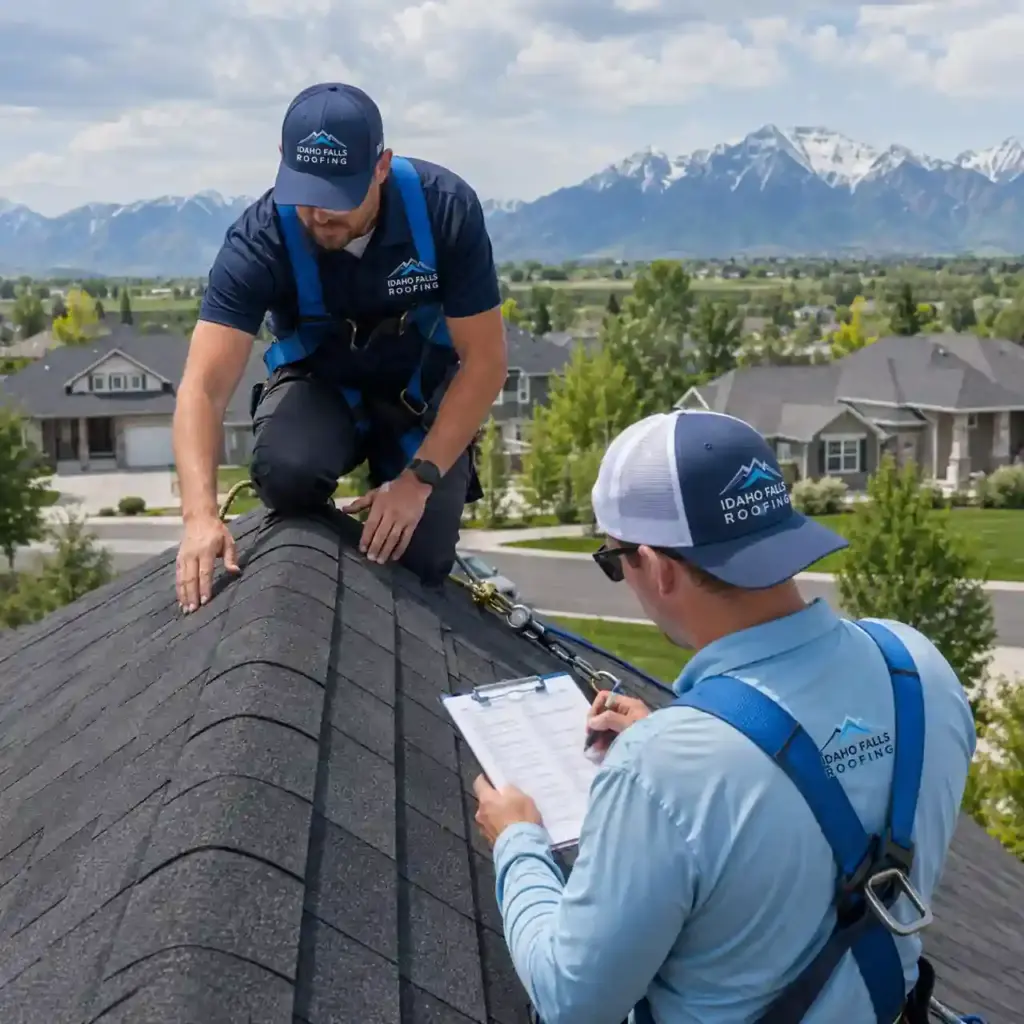
The only way to know for certain is a hands-on inspection. A roofer who’s actually on your roof can tell the difference between one bad section and a roof that’s failing everywhere. A free inspection gives you a straight repair-or-replace answer, not a guess from a photo.
Quick Answers
How do I know if my roof needs a full replacement?
Widespread granule loss, repeated leaks in different spots, soft or sagging decking, or a roof near 20 to 25 years old are all signs that replacement will save you money over repeated repairs.
Is a roof repair a temporary fix?
Not necessarily. A well-done repair on an otherwise healthy roof can add years of service. It only becomes a temporary fix if the underlying roof is already failing broadly.
Can I repair just part of my roof?
Yes, if the damage is limited to one section and the rest of the roof is in good condition, a targeted repair is often the right call.
Will insurance pay for a repair or only a full replacement?
Insurance typically covers whatever scope of work is needed to restore the roof, whether that’s a repair or full replacement, based on the adjuster’s assessment of the damage.